
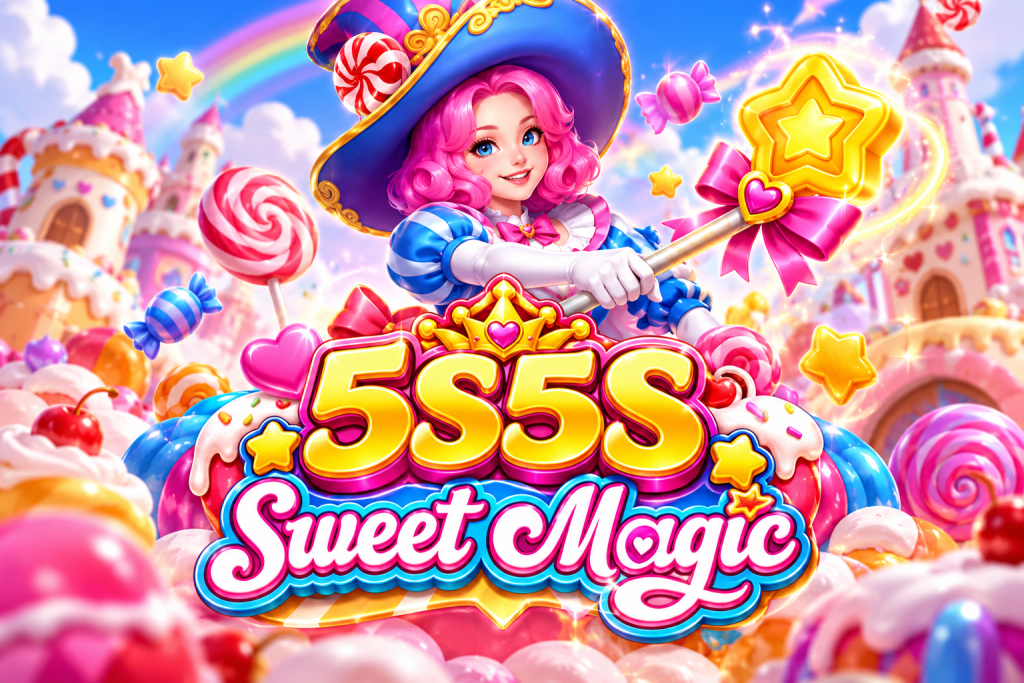
A candy turns into a glowing star. A pink-haired magician waves her wand, and the screen fills with sparkling light. For a moment, it looks as though something important has happened. But has the game actually changed, or is it simply showing an animation?
That question captures one of the most interesting aspects of candy-themed games.
5S5S Sweet Magic presents a colorful fantasy setting built around a cheerful magician, oversized sweets, golden stars, and a candy-covered castle. Its bright artwork creates an inviting atmosphere, but the real challenge for players is understanding what the different visual elements might mean during gameplay.
Not every sparkling symbol represents a special feature. Not every magical transformation changes a result. And a character waving a wand does not necessarily mean that an additional reward has been activated.
Learning to distinguish visual storytelling from actual game mechanics helps players understand what is happening on the screen without relying on assumptions.
A Candy Kingdom Where Every Detail Has a Purpose
The first thing that stands out in Sweet Magic is its visual identity.
Instead of using a traditional treasure chest or royal character, the artwork introduces a young magician dressed in blue, holding a golden wand topped with a glowing star.
Around her are candy canes, pink lollipops, heart-shaped sweets, and pastel-colored buildings.
The scene feels playful rather than intimidating.
Yet these details also provide an opportunity to understand how modern games communicate information.
Consider the magician’s wand.
As a visual element, it establishes the character’s identity. If a game uses the wand in an animation, it may also serve as a storytelling device.
However, whether that animation represents an actual gameplay feature depends entirely on the rules of the particular game.
The same distinction applies to stars, candy symbols, and glowing objects.
An attractive design can make a game memorable, but its artwork alone cannot establish how the underlying mechanics operate.
The Moment a Symbol Changes: Transformation or Animation?
Imagine opening a candy-themed game and watching an ordinary symbol suddenly turn into a bright golden star.
There are several possible explanations.
The symbol might have undergone a genuine transformation defined by the game’s rules. It could also be part of a transition animation, a decorative sequence, or a visual effect that does not alter the underlying result.
The important question is not simply whether the symbol changed appearance.
It is whether the change has a defined gameplay function.
Understanding Symbol Transformation
In games that include a symbol transformation mechanic, one symbol may be replaced by another according to specific rules.
For example, a game might allow a designated symbol to change into a different symbol during a particular feature.
That transformation may affect how the game evaluates the displayed arrangement.
However, transformation rules are not universal. Some games transform individual symbols, while others may affect several positions at once.
Players should therefore look for explanations of which symbols can change, when the transformation occurs, and whether the change affects the result.
When the Change Is Only Visual
A game can also use a transformation-like animation without changing its underlying mechanics.
A candy might briefly glow, rotate, or disappear behind a cloud of sparkles before returning to its original appearance.
In that situation, the animation may simply be decorative.
This is why it is useful to examine the final symbol arrangement and any accompanying information rather than interpreting the animation alone.
Four Questions That Help Explain a Magical Effect
Instead of guessing what a special-looking animation means, players can work through four questions.
What changed?
Identify whether the symbol, its position, its appearance, or only the surrounding animation changed.
Is the change explained in the rules?
Check whether the game’s information section describes the effect as a recognized feature.
How long does it last?
Determine whether the effect applies to a single event, a defined sequence, or remains visible for longer.
Does the displayed information confirm a result?
Look at the game’s actual indicators rather than relying on sound, brightness, or character reactions.
These questions apply broadly to animated games, particularly those featuring magical characters and colorful special effects.
Magic Effects vs. Special Symbols: Why the Difference Matters
One reason candy-themed games can feel confusing is that decorative elements and functional symbols sometimes look similar.
A golden star might appear in the background, on the magician’s wand, or inside the playing area.
Although the artwork is similar, the purpose of each appearance may be completely different.
| Element | Possible Role | What Players Should Check |
|---|---|---|
| Glowing star | Decoration or designated symbol | Is it listed in the game rules? |
| Magic wand animation | Character animation or feature cue | Does it accompany a documented event? |
| Changing candy color | Visual effect or symbol transformation | Does the final symbol actually change? |
| Sparkling background | Atmosphere or transition | Is any game information updated? |
| Special-looking candy | Ordinary or special symbol | Does the paytable identify its function? |
| Screen-wide magical effect | Transition or feature animation | What event does the game say it represents? |
The table illustrates general design possibilities, not verified mechanics of a specific Sweet Magic game.
A symbol should be treated as special because the game defines it that way, not merely because it looks unusual.
A Practical Example: Three Candies and One Golden Star
Consider a hypothetical game with three ordinary candy symbols displayed on the screen.
A magical animation begins, and one candy turns into a golden star.
At first glance, this might appear to be a symbol transformation.
But there are at least three ways to interpret the event.
Scenario One: The star is a defined special symbol.
If the rules identify the star as a special symbol and explain its function, the change may have a mechanical purpose.
Scenario Two: The star appears only during an animation.
If the candy returns to its original form and no rule describes a transformation, the star may simply be part of the visual sequence.
Scenario Three: The animation introduces a separate feature.
In some games, a magical effect may signal the beginning of a feature with its own rules. The player would need to consult the feature description to understand what follows.
The lesson is straightforward: similar-looking animations can represent different events.
A reliable interpretation comes from the rules and displayed information, not from the animation’s appearance.
Why Sweet-Themed Games Use So Many Bright Colors
There is a reason candy-themed artwork often combines pink, yellow, blue, and purple.
These colors create strong visual separation between objects.
A pink candy stands out against a blue background. A golden star becomes easier to recognize among pastel-colored sweets.
In Sweet Magic, the pink-haired magician also contrasts with her blue outfit, while the golden wand creates a clear focal point.
This visual arrangement helps establish a recognizable theme.
But strong colors can also make minor events feel more significant.
A large burst of light may appear dramatic even when it is only part of the game’s presentation.
For that reason, players should avoid equating visual intensity with the importance of a result.
The brightness of an animation does not determine the value or probability of an outcome.
What Players Can Learn from the Game’s Information Screen
Before spending time interpreting magical effects, it helps to become familiar with the game’s instructions.
Depending on the title, an information screen may explain symbol values, feature conditions, special symbol behavior, and other relevant rules.
Here are the details worth examining:
- Symbol definitions: Which images are ordinary symbols, and which have special functions?
- Transformation conditions: Can symbols change, and what triggers the change?
- Feature duration: Does an effect last for one event or multiple events?
- Result display: Where does the game show the final outcome?
- Game-specific restrictions: Are certain features available only under defined conditions?
These details are more useful than trying to infer mechanics from visual effects.
It is also worth remembering that two games with similar candy artwork may use entirely different rules.
A familiar-looking star or lollipop does not guarantee the same function across titles.
Finding Game Information After 5S5S Login
Players who want to explore candy-themed titles can begin by checking the platform’s available game catalog.
After completing 5S5S Login through the correct account-access page, look for a search function or game category if one is provided.
Search for the relevant title and review its description before opening the game.
If Sweet Magic appears in the catalog, check the listed provider and available instructions to confirm that it is the intended title.
This matters because promotional artwork does not necessarily provide complete information about game availability or mechanics.
A title appearing in a poster should not be taken as confirmation that it is currently available on the platform.
The catalog and the game’s own information screen remain the appropriate places to verify those details.
Exploring Candy-Themed Games Through the 5S5S APP
For players who prefer an installed interface, the 5S5S APP may provide another way to access the platform, where officially supported.
The main consideration is not whether an application makes magical animations more impressive. It is whether the interface makes essential information easy to find.
When evaluating an app-based experience, look for readable menus, clearly labeled game information, and straightforward navigation.
The same game rules should not be assumed to change simply because the access method changes.
Before installing any application, verify its official source, compatibility, and requested permissions. Avoid unofficial installation files distributed through unfamiliar links.
An application can make access more convenient, but it does not by itself change the mathematical rules of a game.
A Different Way to Appreciate Sweet Magic
Candy-themed games are often remembered for their bright visuals.
Yet there is another way to appreciate the design: observe how the game communicates information.
Notice whether a particular animation introduces a new event or simply marks a transition.
Look at how symbols are distinguished from background decorations.
Pay attention to where important text appears when the screen becomes busy.
These observations can make complex-looking interfaces easier to understand.
They also help players avoid common assumptions, such as believing that a longer animation must represent a larger result or that a glowing character is predicting what will happen next.
Understanding presentation is useful. Treating presentation as a prediction is not.
Frequently Asked Questions About 5S5S Sweet Magic
What makes the Sweet Magic theme different from other candy-style games?
The artwork centers on a pink-haired magician holding a golden star wand, surrounded by oversized sweets and pastel-colored castles. This gives the theme a fantasy-inspired identity rather than relying only on candy imagery.
Does a glowing candy always indicate a special feature?
No. A glowing candy may be decorative, part of a transition, or a defined symbol effect. Its meaning depends on the rules of the specific game.
What is the difference between symbol transformation and an animation?
Symbol transformation changes a symbol according to a defined mechanic. An animation may change how something looks without altering the actual game state.
Can the magician’s wand predict the next result?
No. A character animation does not establish what the next result will be. Outcomes must be understood through the game’s stated rules, including any applicable random mechanisms.
How can I find Sweet Magic after using 5S5S Login?
Check the available catalog or search function after signing in. Confirm the title and provider before assuming the game matches the promotional artwork.
Is the 5S5S APP required to view candy-themed games?
Not necessarily. Availability depends on the platform’s supported access methods. If browser access is provided, an installed app may not be required.
Do brighter animations mean higher rewards?
No. Animation intensity is a design choice and does not independently establish reward size or the likelihood of an outcome.
Conclusion: Enjoy the Magic, Understand the Mechanics
5S5S Sweet Magic uses a charming magician, colorful candies, glowing stars, and a fantasy castle setting to create a memorable visual identity.
However, the most useful lesson behind this artwork is the difference between what a game shows and what its rules actually mean.
A candy that changes color may represent a genuine transformation, or it may simply be part of an animation. A magical wand can introduce a feature, but it can also serve as decoration.
Players should rely on documented mechanics, symbol explanations, and displayed results rather than visual assumptions.
Whether exploring available titles after 5S5S Login or accessing the platform through the 5S5S APP, understanding the information behind the animations provides a clearer way to experience candy-themed games.
The magic makes the game memorable. Knowing how to read it makes the experience easier to understand.