
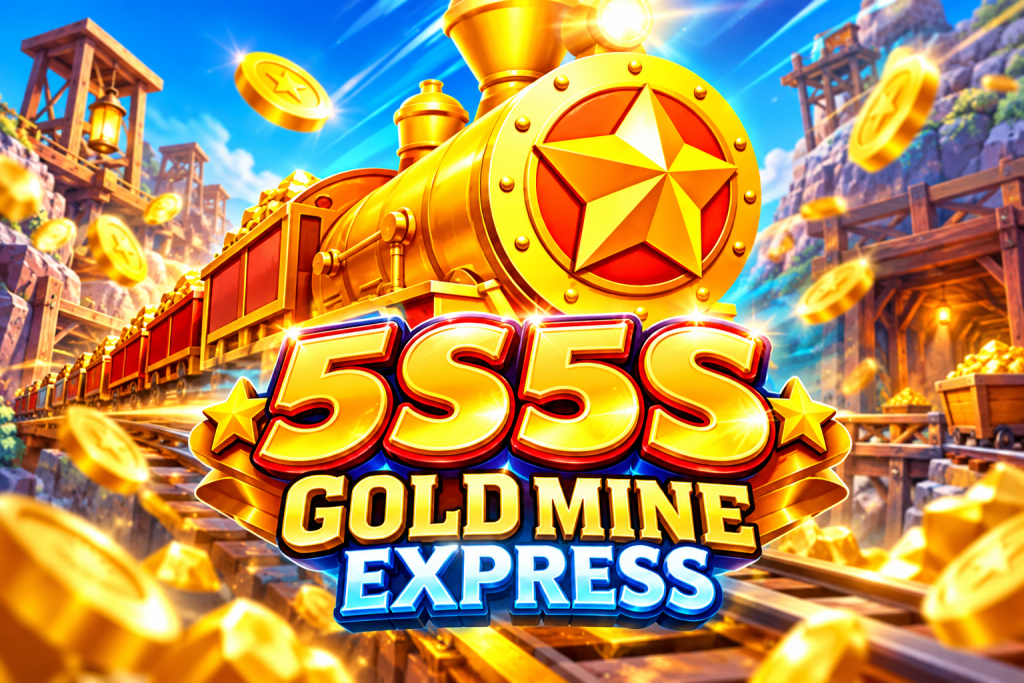
A gold train rushing through a mountain pass is an unusual sight. Unlike an ordinary passenger train, it carries something that immediately changes the atmosphere: a long line of cargo wagons, a powerful locomotive, and the promise of valuable discoveries somewhere beyond the next bend.
That is the visual appeal of Gold Mine Express.
The artwork features a bright golden locomotive traveling through a mining landscape filled with wooden structures, rocky cliffs, railway tracks, and scattered gold coins. The large star on the front of the engine gives the train a distinctive identity, while the cargo wagons suggest a journey built around transporting something valuable.
For players exploring mining-themed games through 5S5S, this setting raises an interesting question. What makes transporting resources different from simply collecting them?
In many resource-management and adventure games, finding valuable materials is only the beginning. Players may also need to consider storage capacity, transportation routes, delivery points, and the conditions required to complete a task.
Gold Mine Express offers a useful visual starting point for understanding these systems, even though the illustration alone does not establish which mechanics are available in any particular game.
A Gold Mine Is More Than a Place to Collect Resources
Mining environments are commonly associated with discovery. Players enter caves, explore rocky terrain, or search for materials hidden beneath the surface.
But resource collection becomes more interesting when the game asks players to decide what happens after those materials have been found.
Imagine a mining game where a player collects gold ore from several locations. The materials are valuable within the game, but they cannot automatically be used everywhere.
Some may need to be stored, processed, or transported to another location.
A railway system creates a natural connection between the mining area and the destination.
Instead of treating resources as numbers that instantly appear in an inventory, a game can make transportation part of its progression system.
This changes how players understand the environment.
A distant mine is no longer just another place to visit. Its location, the route leading to it, and the amount of material that can be transported may all become relevant.
Of course, not every mining-themed game includes these features. Some use trains and gold as visual decoration rather than interactive systems.
The distinction becomes clear only after examining the game’s actual rules.
The Train as a Moving Inventory
One of the most useful ways to understand a cargo train in a game is to think of it as a moving inventory.
A character’s personal inventory may hold tools, materials, or collected objects. A train can serve a similar purpose on a larger scale, carrying resources between different areas.
The difference is that cargo capacity may introduce an additional limitation.
Suppose a fictional mining game allows a train to carry 100 units of ore. A mining site has produced 140 units.
The train cannot transport everything in one trip.
Players may need to leave 40 units behind, arrange another journey, or increase transportation capacity if the game provides that option.
This creates a different kind of challenge from collecting resources alone.
The player is no longer asking only, “How much gold can I find?”
A more practical question becomes, “How much can I move, and where does it need to go?”
Cargo systems can therefore connect collection, storage, and movement into a single sequence.
Why Cargo Capacity Matters
Capacity limits are often introduced to make resource management more deliberate.
Without a limit, players could theoretically move an unlimited quantity of materials whenever transportation becomes available.
A capacity system changes that relationship.
When space is limited, players may need to decide which resources should be transported first.
For example, imagine a game with three fictional materials: gold ore, iron ore, and construction timber.
If all three share the same cargo space, the player may need to consider the current objective before loading the train.
A delivery mission requiring timber would make that material more immediately relevant than gold ore, regardless of how valuable the gold appears.
This is why resource value and resource priority are not always the same thing.
A material can be rare but unnecessary for the current objective. Another material may be common yet essential for completing a particular task.
In well-explained resource-management games, the cargo interface should make these distinctions understandable through item descriptions, capacity indicators, and objective requirements.
The Railway Route Can Be Part of the Challenge
A railway line looks simple when viewed from a distance. The train follows the tracks, reaches its destination, and unloads its cargo.
In games, however, the route itself may introduce decisions.
Some games use fixed routes. Players can send a train between established stations but cannot change the tracks.
Others include railway construction, route selection, or switching points that determine where a train travels.
A more complex system may require players to connect several mining areas to a central station.
Each design creates a different experience.
A fixed route emphasizes timing and delivery requirements. A customizable railway network may place greater importance on planning connections between locations.
The image of Gold Mine Express, with its winding tracks and mining structures, illustrates how a railway can give an environment a clear sense of direction.
Yet the presence of tracks in promotional artwork does not confirm that players can build, change, or control routes.
Those possibilities must be established by the game itself.
What Happens Between Collection and Delivery?
Resource transportation often involves several stages, even when the game presents them as a single activity.
Consider a hypothetical mining mission.
A player discovers a deposit of gold ore in a mountain area. After gathering the required quantity, the ore becomes available for transport.
The player then loads the materials onto a train, sends the train toward a processing station, and waits for delivery to finish.
Once the cargo arrives, the game may mark the objective as complete.
This sequence sounds straightforward, but each stage can have its own conditions.
The mining site may require a certain tool. The train may need sufficient capacity. The destination may accept only particular materials. The delivery may not count until the cargo is unloaded.
Understanding these conditions helps players identify where a task has stopped progressing.
For instance, a player might have collected all the required ore but still see an incomplete objective because the materials have not reached the delivery station.
In that situation, collecting more ore would not necessarily solve the problem.
The missing action is transportation.
When a Full Cargo Train Does Not Mean a Completed Mission
A full train can look like an obvious sign of success.
But in games with delivery objectives, collecting the required materials and completing the task are separate events.
A mission may require a specific destination, a particular cargo type, or a completed unloading process.
Imagine that a player has loaded 80 units of gold ore onto a train. The objective requires delivering 80 units to a refinery.
The quantity is correct, but the mission may remain incomplete while the train is traveling.
If the cargo reaches the wrong station, the objective might still be unfinished.
This distinction is particularly important in games that use progress indicators.
A collection counter measures how much material has been gathered. A delivery counter measures how much has reached the required destination.
Although both counters may refer to the same resource, they do not necessarily track the same action.
Players who understand this difference can interpret mission information more accurately.
The Gold Coins in Gold Mine Express: Decoration or Resource Indicators?
Gold coins are among the most noticeable elements in the Gold Mine Express artwork.
They appear around the locomotive and across the surrounding landscape, giving the scene a lively, celebratory appearance.
However, coins can represent several different things in a game.
They may be part of the background illustration, an in-game resource, a score indicator, or a symbol associated with a particular feature.
These functions should not be treated as interchangeable.
A coin flying across the screen may simply be an animation. It does not necessarily mean that a resource has been added to the player’s inventory.
Similarly, a glowing pile of gold near a railway station may be decorative rather than collectible.
The reliable way to identify a resource is to examine whether the game provides a corresponding counter, inventory entry, or rule explaining its function.
Visual prominence alone does not establish what an object does.
How Mining Themes Create a Sense of Progress
Mining games often communicate progression through changes in the environment.
An area that initially contains only a small mine may later include larger structures, additional equipment, or new transportation connections.
These changes help players see how the game world develops.
A railway is particularly effective for this purpose because it connects separate locations.
When a new section of track becomes available, it can visually suggest that the player has reached another area.
A larger locomotive may communicate an upgrade, while additional cargo wagons can suggest expanded transportation capability.
But these visual changes do not always represent functional upgrades.
A train with more wagons in an illustration may not have greater cargo capacity unless the game’s rules confirm it.
This is an important distinction for players who enjoy visually detailed games.
Progression should be understood through the systems and indicators that the game actually uses, not through appearance alone.
Exploring Mining-Themed Games through 5S5S Login
Players interested in Gold Mine Express-style themes can begin by accessing the platform through 5S5S Login, using a verified website address.
Once signed in, they can browse the available game categories and look for titles featuring mines, railways, treasure transportation, or resource collection.
The title and game provider are worth checking carefully.
Two games may feature similar trains and gold coins while offering completely different experiences.
One might use a railway as a background theme. Another could involve resource management, while a third may focus on symbol-based gameplay.
If a game provides an information or help section, that is the appropriate place to check its objectives and mechanics.
The Gold Mine Express illustration does not independently confirm that a specific title is available in the 5S5S catalog. Availability should be checked on the platform.
Using 5S5S APP to Browse on Mobile
For players who prefer accessing games on an Android device, 5S5S APP may provide another access option if an application is available through a verified source.
When viewing games with detailed environments, it is worth paying attention to how clearly information appears on a smaller screen.
Resource counters, mission descriptions, cargo indicators, and navigation menus should remain readable.
A game that looks spacious on a desktop display may arrange the same information differently on a phone.
That does not necessarily mean its rules have changed.
Before installing an application, users should confirm the download source, review the permissions requested, and check device compatibility.
An Android APK is not an iOS installation file. iPhone and iPad users should rely on a supported browser version or an authorized iOS application if one is available.
Regardless of the access method, the game’s own instructions remain the best reference for understanding its mechanics.
Common Questions About Gold Mine Express and Resource Games
Is Gold Mine Express a railway management game?
The artwork features a gold locomotive, cargo wagons, and a mining environment, but it does not establish the game’s actual genre or mechanics. Players should check the title’s official information before assuming it includes railway management.
What is the difference between collecting and delivering resources?
Collecting adds materials to a character’s inventory or storage system. Delivering usually requires those materials to reach a designated location. Some games treat these as separate objectives.
Does a larger train always carry more resources?
Not necessarily. Cargo capacity depends on the game’s rules. A larger-looking train may be a visual design choice rather than a functional upgrade.
Why might a delivery mission remain incomplete after loading the train?
The objective may require the train to reach a particular station or finish unloading. Players should check the mission conditions and progress indicators.
Do gold coins in the background represent collectible resources?
Not always. Coins may be decorative, part of an animation, or actual game resources. Their purpose should be confirmed through the game’s information and interface.
Can I access mining-themed games through 5S5S Login or 5S5S APP?
These are possible account and application access routes, respectively, subject to availability. The games accessible through them depend on the platform’s current catalog and supported devices.
A Final Look at Gold Mine Express
Gold Mine Express stands out because it brings together two familiar ideas: the excitement of discovering gold and the movement of a train through a rugged mining landscape.
The locomotive, cargo wagons, railway tracks, and scattered coins create a setting that naturally invites questions about how resources move through a game.
In titles that actually use transportation mechanics, collecting materials is only one part of the process. Storage limits, cargo capacity, delivery destinations, and mission requirements can all influence how progression works.
For 5S5S users, the useful approach is to appreciate the theme while checking which mechanics are genuinely supported by the selected game.
A golden train may be the first thing that catches the eye. Understanding what it does, however, requires looking beyond the artwork.